
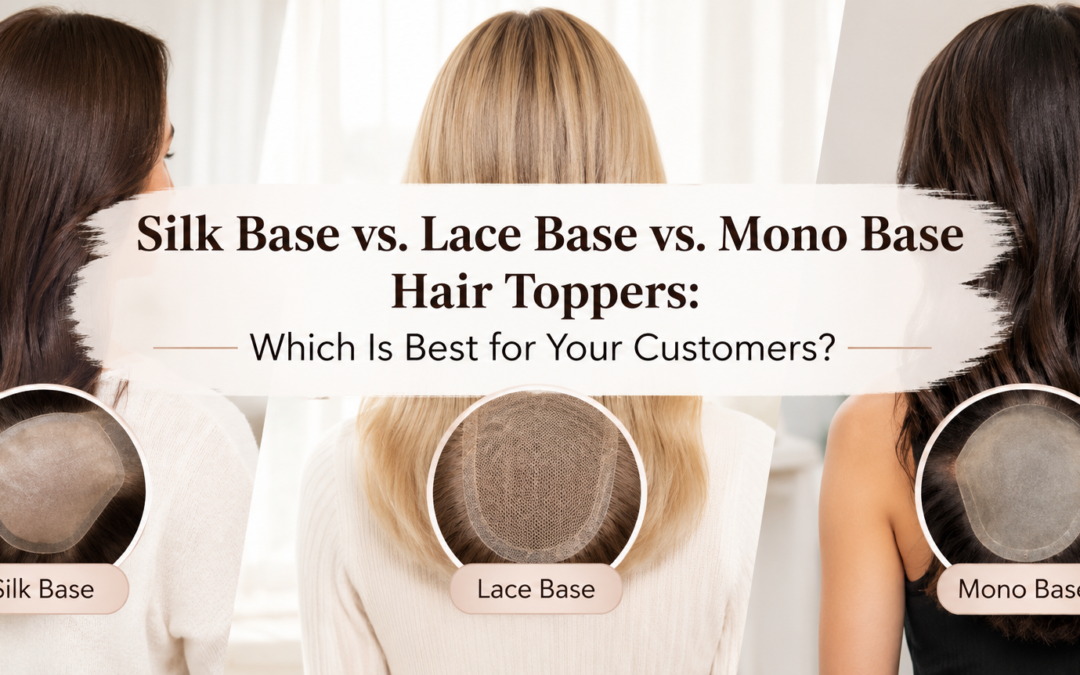
Choosing the right hair topper base is essential for hair brands, wig retailers, salon owners, and distributors serving customers in the United States and Europe. The base material affects the topper’s appearance, scalp realism, durability, breathability, maintenance requirements, and overall customer experience.
Among the most popular options, silk base hair toppers, lace base hair toppers, and mono base hair toppers each offer different advantages. Understanding these differences helps B2B buyers select the right products for their target customers and build a competitive hair topper collection.
In this guide, we compare silk, lace, and mono base hair toppers, explain their key features, and help wholesale buyers determine which option best suits their business.
What Is a Hair Topper Base?
A hair topper base is the foundation onto which human hair is attached. It sits over an area of thinning hair to add coverage, volume, and a natural-looking appearance without requiring a full wig.
The base construction determines how the topper looks at the scalp, how comfortably it can be worn, and how it should be maintained.
For B2B buyers, the most important factors include:
-
Scalp realism: How naturally the base resembles the scalp.
-
Breathability: How comfortably air can circulate through the base.
-
Durability: How well the construction withstands regular wear and maintenance.
-
Hair attachment: How securely individual hairs are knotted, injected, or otherwise attached.
-
Customization: Whether the base can be produced in different sizes, shapes, densities, and colors.
The best base is not necessarily the most expensive one. It is the one that matches your customers’ priorities and your brand’s positioning.
1. Silk Base Hair Toppers: Best for a Natural Scalp Appearance
Silk base hair toppers are designed to create a realistic scalp effect. In a traditional silk base construction, hair knots are concealed beneath a silk-like material or layered structure, helping reduce the visibility of knots at the base.
This construction is particularly attractive to customers who prioritize a natural-looking parting area.
Key Advantages of Silk Base Hair Toppers
Natural-looking scalp effect
The layered construction helps conceal visible knots, creating the appearance that hair is growing directly from the scalp. This can be especially important for customers who frequently expose their parting area.
Premium product positioning
Silk base toppers are often suitable for premium collections because their scalp-like appearance appeals to customers who prioritize realism.
Suitable for different parting styles
Depending on the base design, silk toppers can provide a convincing appearance around the parting area. Buyers should confirm whether the model supports a fixed part, a defined parting area, or more flexible styling.
Potential Limitations
Silk base toppers can feel thicker than some lace constructions because of their layered structure. Breathability and flexibility depend on the specific design, materials, and base size.
They may not be the first choice for customers who prioritize an extremely lightweight base above all other features.
Who Should Choose Silk Base Hair Toppers?
Silk base hair toppers are worth considering for:
-
Premium hair topper brands
-
Customers who prioritize a realistic scalp appearance
-
Salon clients seeking natural-looking coverage
-
Retailers developing higher-value human hair topper collections
For wholesale buyers, silk base toppers can serve as a premium product category alongside lighter lace and mono options.
2. Lace Base Hair Toppers: Best for Lightweight Comfort
Lace base hair toppers use a fine, mesh-like material that allows individual hairs to be attached while maintaining a lightweight construction.
Lace is popular in hair replacement products because it can create a soft, natural-looking hairline and offers a relatively light wearing experience.
Key Advantages of Lace Base Hair Toppers
Lightweight construction
Fine lace can help reduce the feeling of bulk, making it attractive to customers who prefer a lighter topper.
Natural-looking hairline
When properly constructed and matched to the customer’s skin tone and hairstyle, lace can create a discreet transition between the topper and the scalp.
Breathability
The open structure of lace generally allows more airflow than a solid or multilayer base, although actual breathability depends on lace density, additional materials, and the overall construction.
Flexible styling options
Some lace designs support natural-looking parting and styling. The degree of flexibility depends on the base design and the way the hair is attached.
Potential Limitations
Lace can be delicate and may require careful handling during brushing, washing, and maintenance. Customers should avoid excessive pulling and follow the manufacturer’s care instructions.
The knots may also be more visible than those on a well-constructed silk base, depending on the lace design, knot treatment, hair color, and lighting.
Who Should Choose Lace Base Hair Toppers?
Lace base hair toppers are suitable for:
-
Customers who prioritize lightweight comfort
-
Retailers serving customers who want a natural-looking hairline
-
Salons offering discreet hair replacement solutions
-
Brands seeking a lightweight alternative to layered base constructions
For B2B buyers, lace base toppers can complement silk base products by addressing a different set of customer preferences.
3. Mono Base Hair Toppers: Best for Durability and Practical Use
Mono base hair toppers use monofilament material, a fine, mesh-like fabric onto which hairs are individually attached or knotted, depending on the construction.
Mono bases are valued for their balance of natural appearance, practical wear, and structural strength.
Key Advantages of Mono Base Hair Toppers
Practical durability
A well-made mono base can provide a durable foundation for regular use. Actual lifespan depends on the material quality, knotting method, hair quality, frequency of wear, and care routine.
Natural-looking hair distribution
Monofilament construction can create the appearance of hair emerging from the scalp. The final effect depends on the density, knot visibility, base color, and construction method.
Suitable for regular wear
Mono base toppers can be a practical option for customers who want a functional hair replacement solution for frequent use.
Versatile product positioning
Mono bases can suit a variety of topper designs, including different coverage sizes, densities, and hair lengths.
Potential Limitations
Mono bases do not automatically conceal knots as effectively as a well-designed silk base. Depending on the material and construction, they may also feel less soft against the scalp than some fine lace options.
The term “mono base” covers different constructions, so buyers should evaluate the exact material and workmanship rather than relying on the product name alone.
Who Should Choose Mono Base Hair Toppers?
Mono base toppers are worth considering for:
-
Customers who wear toppers regularly
-
Retailers looking for practical everyday products
-
Hair replacement specialists
-
Brands seeking a balance between natural appearance and durability
For B2B buyers, mono base products can form a dependable everyday range within a broader hair topper collection.
Silk vs. Lace vs. Mono Base Hair Toppers: Key Differences
The following comparison summarizes the typical characteristics of each base type. Actual performance varies by construction, material quality, and manufacturing technique.
| Feature | Silk Base | Lace Base | Mono Base |
|---|---|---|---|
| Main advantage | Concealed knots and scalp-like appearance | Lightweight construction | Practical durability |
| Scalp realism | Excellent potential with suitable construction | Natural-looking with suitable color and knot design | Natural-looking with suitable knotting |
| Breathability | Depends on layering and design | Generally high | Depends on mesh density and construction |
| Weight and feel | May feel thicker | Often lightweight | Varies by material |
| Knot visibility | Often reduced by layered construction | May be more visible | Depends on knotting and finishing |
| Maintenance | Follow base-specific care instructions | Requires careful handling | Depends on construction and materials |
| Typical positioning | Premium realism | Lightweight comfort | Everyday practicality |
Which is best? Silk base is a strong option when scalp realism is the main priority. Lace base is worth considering when lightweight comfort and a natural-looking hairline matter most. Mono base can be a practical choice for customers who want a functional topper for regular use.
These are general guidelines, not universal performance guarantees.
How Should B2B Buyers Choose the Right Hair Topper Base?
For wholesalers, salon chains, and private label brands, selecting a base should begin with customer needs rather than manufacturing cost alone.
1. Identify Your Target Customers
Consider who will purchase your products.
-
Premium salon customers: Consider silk base toppers where concealed knots and scalp realism are priorities.
-
Customers seeking lightweight wear: Consider lace base toppers with suitable construction and coverage.
-
Regular-wear customers: Evaluate mono base toppers for their balance of practical use and durability.
These categories can overlap. A customer may prioritize both scalp realism and lightweight comfort, so samples are essential.
2. Choose the Right Base Size
Hair toppers are available in different base dimensions to suit different areas of thinning hair.
A smaller base may suit localized coverage, while a larger base can cover a wider area. The correct size should provide adequate coverage while blending naturally with the customer’s existing hair.
For wholesale orders, consider offering multiple base sizes instead of relying on a single standard dimension.
3. Evaluate Hair Quality
The base is only one part of the finished product. Hair quality also affects the topper’s appearance, styling performance, and lifespan.
When sourcing human hair toppers, evaluate:
-
Hair material and grade
-
Cuticle alignment, where applicable
-
Shedding and tangling performance
-
Color consistency
-
Hair density and distribution
-
Styling and maintenance requirements
If you market a topper as Remy human hair, ensure that the product’s actual materials and processing meet that description.
4. Select the Right Density and Color
Customers in the United States and Europe have diverse hair colors, densities, and styling preferences.
Common commercial options include natural black, dark brown, medium brown, dimensional brunette, rooted blonde, beige blonde, and grey or silver shades.
For customers experiencing natural hair thinning, a density that blends with their existing hair may look more realistic than an unnecessarily thick topper.
Consider offering custom color matching and multiple density options to support salon and retail requirements.
5. Test Samples Before Placing Bulk Orders
Before committing to a wholesale order, evaluate samples under realistic conditions.
Check the base against the scalp, inspect knot visibility, assess comfort, and examine the quality of hair attachment. Follow the manufacturer’s recommended washing and care procedures to understand how the topper performs over time.
Also confirm whether the manufacturer can maintain the same specifications across repeat orders.
Why Work with a Professional Hair Topper Manufacturer?
For distributors, salons, and private label brands, the right manufacturer should offer more than a selection of base materials.
A reliable manufacturing partner should be able to discuss:
-
Silk, lace, and mono base construction options
-
Human hair quality and available textures
-
Custom base sizes and hair densities
-
Color matching and grey hair options
-
Private label packaging and branding
-
Sample evaluation and bulk order quality control
OEM and private label services can help brands develop products that match their target customers instead of selling the same standard specifications as every competitor.
Before placing a large order, confirm the available customization options, minimum order quantities, production lead times, and quality inspection procedures directly with the supplier.
Frequently Asked Questions About Hair Topper Bases
Is silk base better than lace base for hair toppers?
Silk base can be a better choice for customers who prioritize concealed knots and a realistic scalp appearance. Lace base may be preferable for customers who prioritize lightweight construction and breathability. The best choice depends on the design and the customer’s needs.
Are mono base hair toppers durable?
Mono base toppers can be durable when manufactured with suitable materials and workmanship. Their lifespan depends on hair quality, base construction, frequency of use, and maintenance.
Which hair topper base looks the most natural?
A well-constructed silk base can provide excellent scalp realism because its layered structure helps conceal knots. However, lace and mono bases can also look natural when their materials, hair attachment, color, and density are properly matched.
Which hair topper base is best for everyday wear?
There is no single best base for every customer. Mono base may suit customers seeking a practical everyday option, while lace may appeal to those prioritizing a lightweight feel. Silk base can suit regular wear when scalp realism is the primary concern and the design provides suitable comfort.
Can I order custom silk, lace, and mono base hair toppers wholesale?
Many professional hair topper manufacturers offer customization, although available options and minimum order quantities vary. Buyers should confirm base dimensions, hair material, density, color, packaging, and production requirements before ordering.
What should I check before buying hair toppers in bulk?
Evaluate hair quality, base construction, knot visibility, comfort, shedding, color consistency, and sample performance. Also confirm the manufacturer’s production capacity, customization options, lead times, and quality control procedures.
Conclusion: Which Hair Topper Base Is Best for Your Customers?
Silk, lace, and mono base hair toppers serve different needs in the human hair replacement market.
-
Silk base: A strong choice for customers prioritizing a realistic scalp appearance and concealed knots.
-
Lace base: A suitable option for customers seeking lightweight construction and a natural-looking hairline.
-
Mono base: A practical option for customers looking for a balance of natural appearance and everyday usability.
For B2B buyers targeting the USA and European markets, offering more than one base type can help serve different customer preferences and price points.
The most effective product strategy combines suitable base construction, quality human hair, realistic density, appropriate colors, and consistent manufacturing.
Looking for a Hair Topper Manufacturer for Wholesale or Private Label?
Reddmoon works with B2B buyers looking for human hair products and customized manufacturing solutions. If you are a distributor, salon, retailer, or hair brand developing a hair topper collection, contact our team to discuss your product specifications, available base options, and wholesale requirements.
Request product information and discuss your hair topper sourcing requirements with our team.
SEO Keywords
Primary keywords
-
silk base vs lace base vs mono base hair toppers
-
human hair topper manufacturer
-
wholesale human hair toppers
Secondary keywords
-
silk base hair toppers
-
lace base hair toppers
-
mono base hair toppers
-
human hair toppers wholesale
-
custom hair toppers
-
private label hair toppers
-
hair topper supplier
-
OEM human hair toppers
-
hair replacement toppers for salons
Suggested URL slug:/silk-base-vs-lace-base-vs-mono-base-hair-toppers/
Suggested meta title:
Silk vs Lace vs Mono Base Hair Toppers | B2B Guide
Suggested meta description:
Compare silk, lace, and mono base hair toppers. Learn the differences in scalp realism, comfort, durability, and wholesale options for salons and hair brands.
Suggested excerpt:
Discover the differences between silk, lace, and mono base hair toppers. This B2B guide helps salons, retailers, and private label brands choose the right base for their customers.
 Portuguese
 English
 Spanish
 Russian
 German
 French
 Japanese
 Korean
 Danish
 Polish
 Dutch