
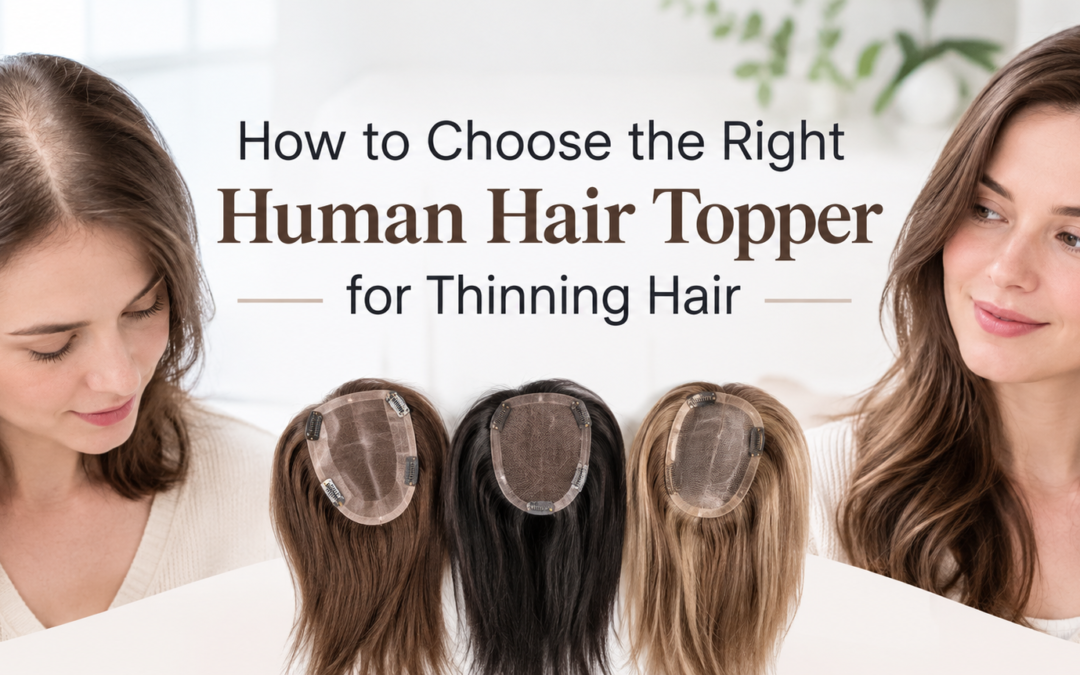
Choosing the right human hair topper for thinning hair requires careful consideration of base construction, hair quality, coverage area, density, color, and comfort. For beauty brands, hair replacement specialists, salons, and distributors, understanding these factors is essential for selecting products that meet customer needs and support long-term business growth.
A high-quality human hair topper can provide natural-looking coverage for thinning areas while blending with the wearer’s existing hair. However, not every topper is suitable for every customer. The best choice depends on the location and extent of thinning, the desired appearance, lifestyle, and personal preferences.
In this guide, we explain how to choose the right human hair topper for thinning hair and what B2B buyers should consider when sourcing hair toppers for the US and European markets.
What Is a Human Hair Topper for Thinning Hair?
A human hair topper is a partial hairpiece designed to cover specific areas of the scalp where hair is thinning. Unlike a full wig, which covers most or all of the head, a hair topper provides targeted coverage while allowing the wearer’s natural hair to remain visible.
Human hair toppers are commonly used to add volume and coverage around the crown, parting, and top of the head.
Compared with synthetic alternatives, human hair toppers generally offer more natural movement, a realistic appearance, and greater styling flexibility, depending on how the hair has been processed.
For B2B buyers, human hair toppers are an important product category for serving customers who want discreet coverage, natural blending, and a premium hair replacement solution.
1. Choose the Right Hair Topper Base
The base is one of the most important factors when selecting a human hair topper. It affects scalp appearance, breathability, styling options, and overall comfort.
Different base constructions suit different customer preferences and coverage requirements.
Silk Base Hair Toppers
Silk base toppers are designed to create the appearance of a natural scalp by concealing the knots or attachment points beneath a silk-like layered construction.
Key benefits include:
-
A realistic scalp appearance.
-
A natural-looking parting area.
-
A polished finish suitable for premium products.
-
An attractive option for customers prioritizing scalp realism.
Silk base hair toppers are often considered for premium collections and customers who want a realistic-looking crown or parting.
For brands and distributors, silk base toppers can be positioned as a premium option within a human hair topper range.
Lace Base Hair Toppers
Lace base toppers feature a lightweight lace foundation that can offer a natural-looking scalp appearance and good airflow.
Common benefits include:
-
Lightweight construction.
-
Breathability.
-
A natural-looking parting area.
-
Flexible styling possibilities, depending on the design.
Lace base toppers may suit customers who prioritize a lightweight feel and a natural appearance.
When sourcing wholesale lace hair toppers, buyers should assess lace softness, durability, knot visibility, and the security of the hair attachment.
Mono Base Hair Toppers
Monofilament, or mono, toppers use a fine mesh-like material that allows individual hairs to be attached in a way that can create the appearance of natural hair growth.
Potential advantages include:
-
Natural-looking hair direction.
-
Flexible parting options, depending on the construction.
-
A balance between realism and practical wear.
-
Suitability for selected everyday hair replacement needs.
Mono toppers are worth considering for brands serving customers who prioritize versatility and a natural-looking part.
How Should B2B Buyers Choose Between Different Bases?
There is no single best base for every customer.
Silk bases can be attractive for premium scalp realism, lace bases for lightweight construction, and mono bases for natural-looking hair direction and practical versatility. The actual performance depends on the materials, construction, and design of the individual product.
For a balanced product range, hair topper brands may consider offering two or three base options to serve different customer preferences and price points.
2. Select the Right Coverage Size
The coverage area should match the location and extent of thinning.
A topper that is too small may not provide sufficient coverage, while a larger base may offer more coverage than the customer needs.
Common coverage considerations include:
-
Crown thinning: A compact topper may be sufficient when thinning is limited to the crown.
-
Parting-line thinning: A design that provides suitable coverage along the parting area may be preferable.
-
Wider top-of-head thinning: A larger base may be needed to cover a broader area.
-
More extensive hair loss: A larger topper or another hair replacement option may be more appropriate, depending on the individual’s needs.
For B2B buyers, offering several base sizes can help retailers and salons serve a wider range of customers.
Product specifications should clearly state base dimensions and explain the coverage area. Customers should be encouraged to compare these measurements with their own thinning area before purchasing.
3. Choose the Appropriate Hair Density
Hair density describes how much hair is attached to the topper base. It directly affects the appearance, volume, and weight of the finished hairpiece.
The right density should blend with the customer’s existing hair rather than simply maximize volume.
Light Density
Light-density toppers can be suitable for customers who want subtle coverage and a softer, less voluminous appearance.
They may blend more easily with naturally fine hair when the color, length, and base construction are also appropriate.
Medium Density
Medium-density toppers provide a balance between coverage and volume. They may suit customers who want visible fullness without an overly heavy appearance.
High Density
High-density toppers provide more volume and may be appropriate for customers who prefer a fuller hairstyle or need more visual coverage.
However, higher density does not automatically mean better quality. Excessive density can make a topper look less natural when it does not match the wearer’s existing hair.
For wholesale buyers, it is useful to compare density samples across different lengths and base sizes before establishing a product range.
4. Select High-Quality Human Hair
Hair quality is another major consideration when choosing a human hair topper.
For premium products targeting the United States and Europe, buyers should evaluate hair texture, cuticle condition, processing history, shedding, tangling, and consistency between batches.
Remy Human Hair
Remy human hair is generally characterized by hair collected and arranged with the cuticles aligned in the same direction.
When properly processed and manufactured, Remy hair can offer:
-
Natural movement and appearance.
-
Better manageability.
-
Reduced friction-related tangling.
-
Styling flexibility when the hair and construction permit it.
However, the term “Remy” alone does not guarantee a particular lifespan or quality level. Buyers should request samples and evaluate actual performance.
Virgin Human Hair
Virgin human hair generally refers to hair that has not undergone chemical processing such as coloring or perming before sale. Supplier definitions can vary, so buyers should confirm exactly what processing the hair has received.
Virgin hair may be suitable for premium product lines, but it should not be assumed to be superior to every properly manufactured Remy product in every application.
What Should Buyers Test?
Before placing a bulk order, evaluate:
-
Hair softness and natural movement.
-
Shedding during brushing and washing.
-
Tangling after repeated wear and washing.
-
Color consistency.
-
Performance after styling within the manufacturer’s recommended temperature range.
-
Consistency between the approved sample and bulk production.
For a private label hair topper brand, these checks help reduce quality-related complaints and protect brand reputation.
5. Match the Hair Color to the Customer’s Natural Hair
Color matching is essential for a natural-looking human hair topper.
Even a well-constructed topper can look unnatural if its color differs noticeably from the wearer’s existing hair.
Popular color categories for the US and European markets include:
-
Natural black.
-
Dark brown and chocolate brown.
-
Medium brown and light brown.
-
Blonde and beige blonde.
-
Rooted blonde and rooted brunette.
-
Balayage and dimensional color blends.
-
Grey and silver shades.
Dimensional colors, such as rooted blonde or blended brunette, may help the topper blend with hair that contains natural highlights or multiple tones.
For B2B buyers, it is useful to request physical color swatches or sample toppers rather than relying exclusively on screen images. Lighting, camera settings, and monitor calibration can change how a color appears online.
A supplier should also explain how color variations are managed across repeat orders.
6. Select the Right Hair Length and Texture
The topper should blend with the wearer’s existing hair in both length and texture.
Popular texture options include:
-
Straight hair.
-
Silky straight hair.
-
Natural wave.
-
Body wave.
-
Soft curl.
Straight and natural-wave toppers can be useful core products for brands serving customers who prefer everyday hairstyles. Body wave and soft curl options can serve customers who want additional movement or volume.
Available lengths should be selected according to the brand’s target audience and product positioning. For example, shorter and medium-length toppers may suit customers looking for subtle crown coverage, while longer options may be appropriate for customers who want a fuller hairstyle.
For professional brands, consistency between the listed length and the finished product is particularly important. Buyers should confirm how length is measured and whether the stated length refers to straightened hair or the hair in its natural texture.
7. Consider Attachment Methods and Daily Comfort
Hair toppers can use different attachment systems, including pressure-sensitive clips, depending on the product design.
When evaluating a topper, consider:
-
Whether the attachment method suits the customer’s hair and scalp.
-
Whether the clips or other fasteners are securely constructed.
-
Whether the base feels comfortable during normal wear.
-
Whether the topper can be removed and reattached as intended.
-
Whether the product’s care instructions are clear.
Customers with very fragile hair or sensitive scalps may need additional guidance when selecting an attachment method. A topper should not cause pain or excessive tension.
For brands and salons, product education is an important part of the customer experience. Clear instructions on fitting, removal, cleaning, and storage can help customers use their toppers appropriately.
8. How Can B2B Buyers Evaluate a Hair Topper Manufacturer?
For wholesalers, distributors, salons, and private label brands, selecting the right manufacturer is just as important as choosing the right topper design.
A reliable human hair topper manufacturer should be able to explain product specifications clearly and demonstrate consistent manufacturing practices.
Check Base Construction
Ask the supplier to explain the differences between its silk, lace, and mono base products. Request close-up images or samples so that you can inspect the material, hair attachment, and finish.
Confirm Hair Specifications
Ask for details about the hair type, processing history, density, length measurement, and available colors.
Product claims should be clear and consistent with the actual materials used.
Test Samples Before Bulk Orders
Evaluate samples under realistic conditions. Compare hair quality, base comfort, color accuracy, shedding, and styling performance.
A sample approval process should establish clear expectations for subsequent production batches.
Review OEM and Private Label Capabilities
If you are developing your own hair topper brand, ask whether the manufacturer supports:
-
Custom base sizes.
-
Different hair densities and lengths.
-
Custom colors and textures.
-
Branded packaging and labels.
-
Product specification sheets.
-
Repeat-order quality standards.
These capabilities can help a brand develop a differentiated product range instead of relying entirely on standard catalog products.
Evaluate Communication and Quality Control
A professional supplier should provide clear quotations, confirm specifications in writing, communicate production timelines, and explain how quality issues are handled.
For long-term B2B cooperation, consistent communication and repeatable quality standards are more valuable than a low initial quotation alone.
9. Build the Right Human Hair Topper Product Range
For brands entering or expanding in the US and European markets, a focused product range can be easier to manage than offering too many variations at once.
A practical starting assortment could include:
Core collection
-
Natural brown and blonde shades.
-
Straight and natural-wave textures.
-
Commonly requested base sizes.
-
Light and medium density options.
Premium collection
-
Silk base toppers.
-
Carefully blended rooted colors.
-
Additional density and length choices.
-
Customized packaging.
Specialty collection
-
Grey and silver toppers.
-
Alternative base constructions.
-
Custom color blends.
-
Products designed for specific coverage requirements.
The final assortment should be guided by customer feedback, sample testing, order history, and the brand’s positioning rather than assumptions about a single universal best-seller.
Frequently Asked Questions About Human Hair Toppers for Thinning Hair
What is the best human hair topper for thinning hair?
The best topper depends on the location and extent of thinning, desired coverage, natural hair color, preferred density, and comfort requirements. Silk, lace, and mono bases each offer different characteristics, so customers should compare product specifications before choosing.
Is a silk base topper better than a lace base topper?
Neither is universally better. Silk base toppers can offer a realistic-looking scalp appearance, while lace base toppers can provide lightweight construction and airflow. The best choice depends on the specific design and the wearer’s priorities.
What hair density looks most natural for thinning hair?
A density that blends with the wearer’s existing hair usually looks more natural than simply choosing the highest density. Light or medium density may suit some customers, while others may prefer more volume.
Is Remy human hair suitable for hair toppers?
Yes. Remy human hair is commonly used in premium toppers because aligned cuticles can help reduce friction-related tangling. Actual performance still depends on hair quality, processing, base construction, and care.
Can human hair toppers be colored or heat-styled?
Some human hair toppers can be heat-styled or professionally colored, but suitability depends on the hair’s processing history and the manufacturer’s instructions. Bleaching or aggressive chemical treatments can damage the hair and may affect the base. Always test a small section and consult the supplier before chemical processing.
How should a brand choose a wholesale hair topper supplier?
A brand should evaluate hair quality, base construction, available sizes, color consistency, sample performance, customization capabilities, production reliability, and communication. Written specifications and approved samples help establish clear standards for bulk orders.
Can manufacturers produce private label human hair toppers?
Many manufacturers offer OEM or private label services, which may include custom base sizes, density, hair length, color, labels, and packaging. Buyers should confirm available options, minimum order quantities, sampling costs, and production timelines directly with the manufacturer.
Conclusion: Choose the Right Human Hair Topper for Your Market
Choosing the right human hair topper for thinning hair requires a balance of natural appearance, suitable coverage, appropriate density, reliable hair quality, and comfortable construction.
For consumers, the right topper should blend with their existing hair and meet their daily styling needs. For salons, distributors, and private label brands, success also depends on finding a manufacturer that can maintain consistent specifications and support repeat orders.
By carefully evaluating base construction, hair quality, color, length, density, and supplier capabilities, B2B buyers can build a human hair topper collection that better serves their customers in the United States and Europe.
Looking for a Wholesale Human Hair Topper Manufacturer?
Reddmoon supports B2B buyers looking for human hair products and customized manufacturing solutions. If you are developing a hair topper brand, supplying professional salons, or expanding your wholesale product range, discuss your requirements with our team.
Contact us to inquire about available human hair topper styles, base constructions, color options, sample orders, and OEM or private label services.
Request product details and wholesale pricing to explore the right human hair topper options for your business.
 Korean
 English
 Spanish
 Russian
 German
 French
 Japanese
 Danish
 Polish
 Dutch
 Portuguese