
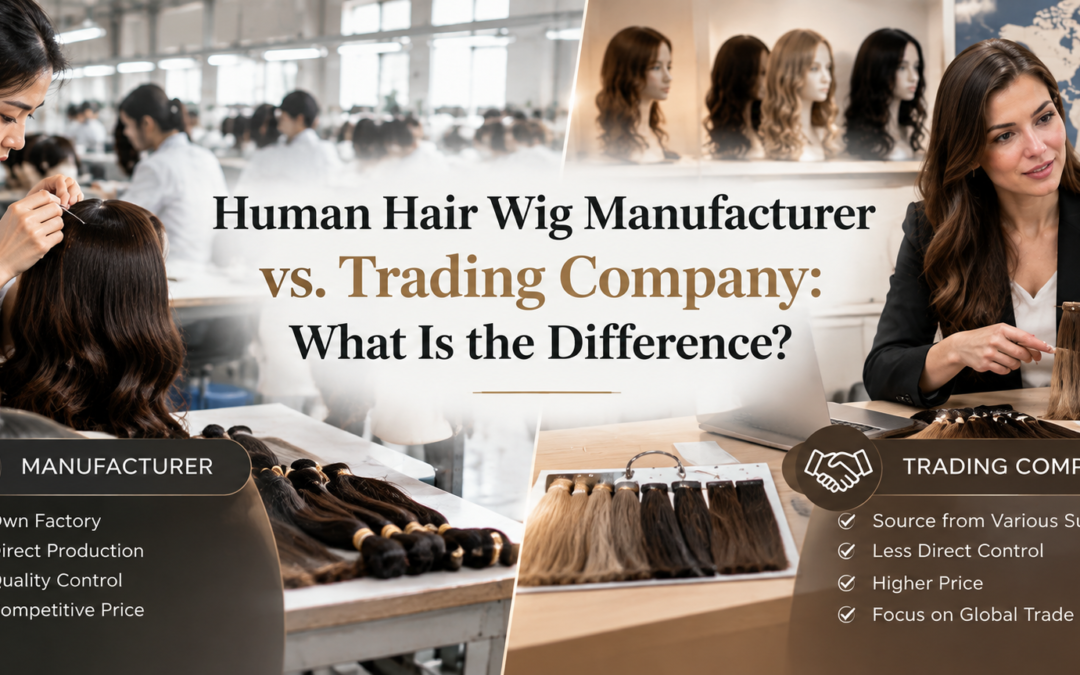
When sourcing human hair wigs for a salon, wig store, online business, or private label brand, choosing the right supplier is an important part of building a reliable supply chain.
Many international buyers work with either a human hair wig manufacturer or a trading company. Although both can supply human hair wigs, their business models, production capabilities, customization options, pricing structures, and communication processes can be different.
Understanding the difference between a human hair wig manufacturer and a trading company can help wholesale buyers make a more informed sourcing decision.
What Is a Human Hair Wig Manufacturer?
A human hair wig manufacturer is a company that operates or directly manages the production of human hair wigs.
Depending on the manufacturer, its production capabilities may include:
-
Human hair sourcing and selection
-
Hair sorting and processing
-
Wig cap construction
-
Hair ventilation and knotting
-
Hair coloring
-
Hair cutting and styling
-
Wig customization
-
Quality inspection
-
Packaging and labeling
-
OEM and ODM production
A manufacturer usually has a direct connection to the production process. This allows buyers to communicate specifications directly with the company responsible for manufacturing the wigs.
For brands ordering custom products, this can be particularly important because details such as hair quality, density, length, color, cap construction, lace type, and packaging may need to be controlled throughout production.
What Is a Trading Company?
A trading company generally does not manufacture the products itself.
Instead, a trading company may purchase wigs from one or more factories and then sell them to international customers.
A trading company can provide useful sourcing services, including:
-
Product sourcing
-
Supplier coordination
-
Export services
-
Product selection
-
Order management
-
Customer communication
-
Logistics coordination
Some trading companies work with multiple factories, which may allow them to offer a wider range of products.
However, the actual production of the wig may take place at another company.
Human Hair Wig Manufacturer vs. Trading Company
The key difference is the relationship with production.
| Factor | Human Hair Wig Manufacturer | Trading Company |
|---|---|---|
| Production | Directly manufactures or manages manufacturing | Usually purchases from factories |
| Factory communication | Direct | Usually through the trading company |
| Customization | Often more flexible | Depends on partner factories |
| Product development | Can develop products directly | Usually coordinates with factories |
| OEM/ODM | Usually available | Depends on manufacturing partners |
| Quality control | Can control production directly | Relies on selected factories |
| Pricing structure | Often closer to factory pricing | May include additional sourcing margin |
| MOQ | Can sometimes be flexible | Depends on the factory |
| Custom packaging | Usually available | Depends on factory capabilities |
| Production lead time | Managed directly | Depends on the factory |
These differences do not mean that every manufacturer is better for every buyer or that every trading company provides the same level of service. The right choice depends on the buyer’s business model, order volume, customization requirements, and sourcing goals.
Why Do B2B Buyers Work Directly With Wig Manufacturers?
For established wig brands, wholesalers, salons, and online retailers, working directly with a manufacturer can provide several practical advantages.
1. More Direct Communication
When buyers communicate directly with a manufacturer, product specifications can be discussed with the company responsible for production.
For example, a buyer may need:
-
100% human hair
-
Specific hair length
-
Specific density
-
Custom hair color
-
Lace front construction
-
Glueless cap
-
Custom cap size
-
Specific wave or curl pattern
-
Private label packaging
Direct communication can make it easier to confirm whether these specifications can be produced and how they will affect cost and production time.
2. Greater Customization Potential
Customization is particularly important for private label wig brands.
A manufacturer may be able to customize different parts of a wig, including:
Hair
-
Length
-
Density
-
Color
-
Texture
-
Hair type
Cap
-
Cap size
-
Cap construction
-
Lace material
-
Lace color
-
Parting design
Branding
-
Logo
-
Labels
-
Packaging
-
Hang tags
-
Product cards
The exact customization options depend on the manufacturer’s production capabilities.
3. More Efficient Product Development
If a brand wants to develop a new wig style, direct communication with the manufacturing team can simplify the sample-development process.
For example, a buyer could provide a reference image or technical specifications and discuss:
-
Product concept
-
Hair specifications
-
Cap construction
-
Sample production
-
Sample evaluation
-
Adjustments
-
Final approval
-
Bulk production
This process is particularly useful for brands developing their own product collections.
4. Better Supply Chain Visibility
Working directly with a manufacturer can give buyers more visibility into the production process.
A buyer can ask questions such as:
-
Where is the product manufactured?
-
What type of hair is being used?
-
How is the hair processed?
-
How is the wig constructed?
-
What quality checks are performed?
-
How long does production take?
-
Can the same specifications be reproduced for future orders?
Clear answers to these questions can help buyers evaluate a potential supplier.
Are Human Hair Wigs From Trading Companies Lower Quality?
Not necessarily.
A trading company may work with experienced and reliable wig factories and provide good products and services.
The important question is not simply whether a supplier is a manufacturer or trading company. Buyers should also evaluate:
-
Hair quality
-
Product consistency
-
Manufacturing experience
-
Sample quality
-
Quality control procedures
-
Communication
-
Customization capability
-
MOQ
-
Production capacity
-
Lead time
-
After-sales service
A trading company can be suitable for buyers who need product sourcing or multiple categories from different suppliers.
A manufacturer can be particularly suitable for buyers who want direct production communication, long-term product development, or private label manufacturing.
Which Is Better for Private Label Wig Brands?
For a private label wig brand, the manufacturing relationship can be especially important.
Private label products usually require more than simply purchasing ready-made wigs.
A brand may need to customize:
-
Hair quality
-
Hair color
-
Wig density
-
Hair length
-
Cap construction
-
Lace
-
Logo
-
Labels
-
Packaging
-
Product specifications
Because these details are connected to production, a direct relationship with a manufacturer can make product development and ongoing production easier to coordinate.
However, buyers should always verify the manufacturer’s actual capabilities rather than relying only on the word “factory” in a supplier’s marketing materials.
How Can You Tell if a Wig Supplier Is a Real Manufacturer?
Before placing a large wholesale order, buyers can ask potential suppliers several practical questions.
Ask About the Factory
Questions can include:
-
Where is your manufacturing facility located?
-
Do you operate your own factory?
-
What wig products do you manufacture?
-
How many years have you been producing human hair wigs?
-
What is your monthly production capacity?
Ask About Customization
Ask whether the company can customize:
-
Hair color
-
Hair density
-
Hair length
-
Cap construction
-
Lace
-
Hair texture
-
Logo
-
Packaging
Ask for Samples
A sample order can help buyers evaluate:
-
Hair softness
-
Hair direction
-
Hair density
-
Hair shedding
-
Lace quality
-
Cap construction
-
Hairline appearance
-
Overall workmanship
A sample is usually more useful than evaluating a supplier only from product photos.
Ask About Production
Buyers should also ask:
-
What is the MOQ?
-
What is the sample lead time?
-
What is the bulk production lead time?
-
How is quality inspected?
-
Can the supplier reproduce the same specifications for future orders?
These questions can help determine whether a supplier is suitable for long-term B2B cooperation.
What Is the Difference in Pricing?
The final price of a human hair wig depends on many factors, including:
-
Hair type
-
Hair origin
-
Hair length
-
Hair density
-
Hair color
-
Cap construction
-
Lace material
-
Customization
-
Order quantity
-
Packaging
-
Shipping requirements
A trading company may purchase products from a manufacturer and then add its own margin and service costs.
A direct manufacturer may have a more direct cost structure because the buyer is communicating with the production source.
However, factory-direct does not automatically mean the lowest price.
A professional buyer should compare the complete value of the quotation, including product specifications, quality, customization, MOQ, production time, packaging, and service.
Manufacturer or Trading Company: Which Should You Choose?
There is no single supplier model that is suitable for every business.
A human hair wig manufacturer may be a suitable option if you:
-
Run a wig brand
-
Need private label products
-
Require custom wigs
-
Need consistent product specifications
-
Plan to place repeat wholesale orders
-
Want to develop your own product line
-
Need direct communication with production
A trading company may be suitable if you:
-
Need products from multiple factories
-
Want a broader range of products
-
Prefer a sourcing intermediary
-
Have smaller or mixed product requirements
-
Need assistance coordinating multiple suppliers
The best approach is to evaluate the supplier based on your actual business requirements rather than choosing solely based on the label “manufacturer” or “trading company.”
Why Work With a Professional Human Hair Wig Manufacturer?
For businesses planning long-term cooperation, the manufacturing partner can become an important part of the supply chain.
A professional human hair wig manufacturer should be able to provide clear information about:
-
Product specifications
-
Hair quality
-
Manufacturing capabilities
-
Customization
-
MOQ
-
Production lead times
-
Quality control
-
Packaging
-
OEM/ODM services
-
Private label production
At YIVLUX, we focus on human hair wigs, hair toppers, hair extensions, and customized hair solutions for international B2B customers.
Our manufacturing capabilities support wholesale orders as well as OEM, ODM, and private label projects. Buyers can discuss product specifications, customization requirements, packaging, and branding requirements with our team before production.
Frequently Asked Questions
Is a wig manufacturer cheaper than a trading company?
Not necessarily. A manufacturer’s quotation may have a more direct connection to production costs, while a trading company may include sourcing and service costs. Buyers should compare the complete quotation based on the same product specifications.
What is the main difference between a wig factory and a trading company?
A wig factory directly manufactures or manages the production of wigs, while a trading company generally sources products from manufacturing partners and sells them to customers.
Can a trading company provide OEM wigs?
Yes. Some trading companies can coordinate OEM production through partner factories. Buyers should confirm which factory will manufacture the product and who is responsible for quality control.
Can a human hair wig manufacturer provide private label services?
Many manufacturers provide private label services, including customized wigs, logos, labels, packaging, and product specifications. The available services vary by manufacturer.
How do I verify a human hair wig manufacturer?
Ask about the company’s factory, production capabilities, manufacturing experience, customization options, MOQ, quality control procedures, and sample process. Buyers can also request factory photos, videos, samples, or arrange a factory visit when appropriate.
What should I ask a human hair wig supplier before placing an order?
Important questions include hair type, hair quality, density, length, cap construction, customization options, MOQ, sample cost, production time, quality control, packaging, payment terms, and shipping arrangements.
Final Thoughts
The main difference between a human hair wig manufacturer and a trading company is their relationship with the production process.
A manufacturer directly produces or manages the manufacturing of wigs, while a trading company generally sources products from one or more factories.
For salons, wholesalers, retailers, and established hair brands, understanding this difference can make supplier evaluation easier. Instead of focusing only on price, buyers should compare manufacturing capabilities, product quality, customization, communication, MOQ, production capacity, and long-term supply reliability.
For businesses looking to develop customized human hair wigs or private label products, working directly with a capable manufacturer can provide a more direct connection to product development and production.
YIVLUX provides human hair wigs, hair toppers, hair extensions, and customized OEM/ODM and private label solutions for B2B buyers. Contact our team to discuss your product requirements, sample development, and wholesale order needs.
 Spanish
 English
 Russian
 German
 French
 Japanese
 Korean
 Danish
 Polish
 Dutch
 Portuguese