
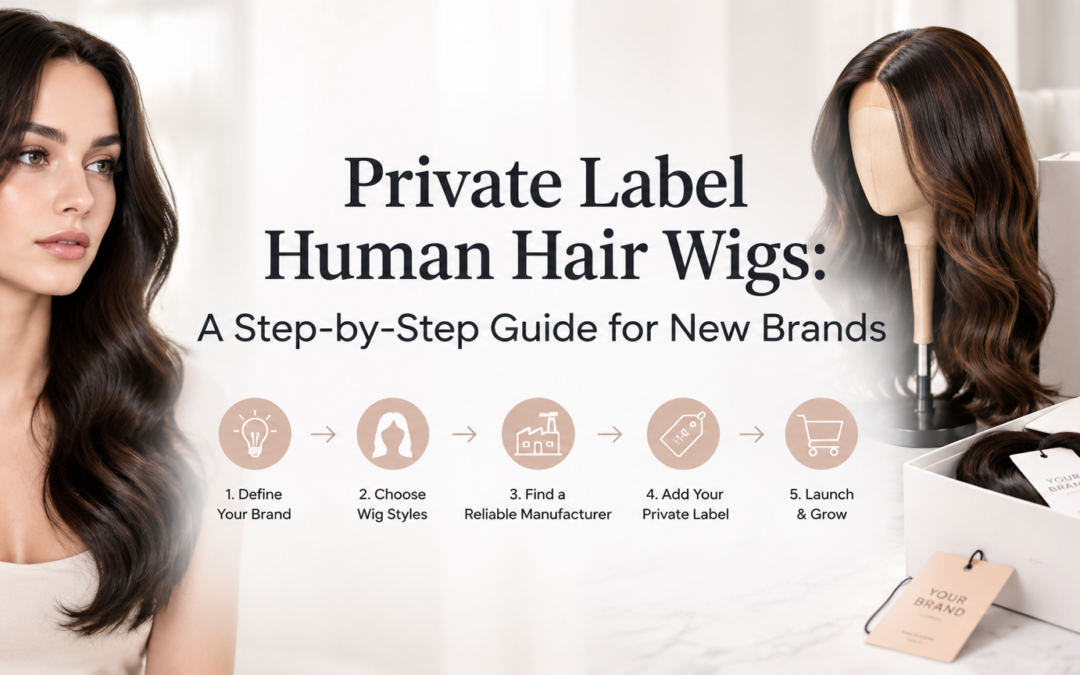
Launching a private label human hair wig brand is an opportunity for entrepreneurs, beauty retailers, salon owners, and distributors looking to build their own products in the competitive US and European beauty markets. By working with an experienced human hair wig manufacturer, businesses can develop branded products without establishing their own production facilities.
However, building a successful wig brand involves more than choosing a product and adding a logo. New brands need to select the right wig types, define product specifications, evaluate hair quality, design packaging, and establish a reliable supply chain.
In this guide, we explain how to start a private label human hair wig business step by step, from product planning to wholesale production.
What Are Private Label Human Hair Wigs?
Private label human hair wigs are wigs manufactured by a supplier and sold under another company’s brand name. Depending on the manufacturer’s capabilities, buyers can customize the packaging, labels, wig construction, hair color, length, density, and other product specifications.
Private label wig manufacturing allows businesses to build their own brand without investing in a complete wig production facility.
Typical private label services include:
-
Custom logo labels and packaging
-
Human hair wig selection and customization
-
Lace, silk, and other wig cap options
-
Custom lengths, densities, and colors
-
OEM and product development services
-
Wholesale production for growing brands
Private label human hair wigs are suitable for online beauty stores, wig boutiques, professional salons, distributors, and emerging beauty brands targeting the United States and Europe.
Step 1: Define Your Target Market and Brand Positioning
Before contacting a human hair wig manufacturer, determine who your customers are and how you want your brand to compete.
For example, a premium wig brand may focus on natural-looking lace front wigs, realistic hairlines, and customized colors. An online retailer may prioritize versatile styles, attractive packaging, and products that are easy to present through product photography and video.
Consider the following business models:
Premium wig brands: Focus on natural hairlines, high-quality human hair, refined construction, and consistent product performance.
Salon and professional wig businesses: Prioritize reliable quality, a broad selection of colors and lengths, and products suited to professional styling.
Online wig stores: Emphasize clear product specifications, visual presentation, packaging, and repeatable product quality.
Wholesale distributors: Look for competitive bulk pricing, dependable production capacity, and a product range that serves multiple customer segments.
A clearly defined target market helps you choose the right products and avoid investing in too many variations at the beginning.
Step 2: Choose the Right Types of Human Hair Wigs
Selecting the right wig styles is one of the most important decisions for a new private label brand.
Different wig constructions serve different customer preferences and price positions.
Lace Front Wigs
Lace front wigs feature lace across the front hairline to create a natural-looking appearance when properly fitted and styled. They are suitable for brands targeting customers who value realistic hairlines and versatile styling.
Full Lace Wigs
Full lace wigs feature a lace base across the entire cap, offering flexibility in styling and parting. They may suit premium product lines, depending on construction quality and customer requirements.
HD Lace Wigs
HD lace is designed to be thin and less visible against the scalp when correctly matched and installed. Buyers should evaluate lace durability, color suitability, and overall construction rather than relying on the HD label alone.
Silk Top Wigs
Silk top wigs use a silk-based construction designed to create the appearance of a natural scalp. They can be suitable for customers who prioritize a realistic-looking parting area.
Glueless Wigs
Glueless wigs are designed to be worn without traditional adhesive application, although fit and security depend on cap construction, adjustable straps, combs, and other design features.
For a new brand, it is usually more practical to begin with a focused selection of wig types that match your target customers instead of launching every construction at once.
Step 3: Select the Right Human Hair Quality
Hair quality directly affects product appearance, styling performance, customer satisfaction, and repeat purchases.
When sourcing private label human hair wigs, buyers should understand the difference between common hair descriptions.
Remy human hair: Remy hair generally refers to human hair collected and processed with the cuticles aligned in the same direction. Proper cuticle alignment can help reduce friction and tangling, although final performance also depends on processing and maintenance.
Virgin human hair: This term commonly describes human hair that has not undergone chemical processing such as coloring or perming. Buyers should ask suppliers to clarify the exact definition and processing history used for their products.
Raw human hair: Raw hair generally refers to hair that has undergone minimal processing, but industry usage is not completely standardized. Request clear documentation of the supplier’s specifications instead of relying on the label alone.
Before placing a bulk order, request samples and evaluate softness, shedding, tangling, color consistency, and performance after washing. If you intend to sell wigs as heat-stylable or color-customizable, confirm the appropriate care instructions and limitations with the manufacturer.
Step 4: Customize Wig Specifications
A private label human hair wig brand should have clear product specifications before production begins.
Important customization options include:
-
Hair length: Select lengths that match your intended customer and price range.
-
Hair density: Choose density according to the desired appearance, weight, and styling requirements.
-
Hair texture: Options may include straight, body wave, loose wave, and curly textures.
-
Hair color: Consider natural black, brown shades, blonde, rooted colors, and balayage blends where available.
-
Cap construction: Choose lace front, full lace, silk top, or other suitable designs.
-
Lace details: Confirm lace type, color, dimensions, and hairline construction.
-
Parting options: Define whether the wig has a fixed part, a defined parting area, or more flexible parting.
-
Cap size: Confirm the intended size range and available adjustment features.
The best specifications depend on your customers, brand positioning, and budget. A manufacturer should help clarify which combinations are feasible and how each option affects production cost.
Step 5: Find a Reliable Private Label Wig Manufacturer
Choosing the right manufacturer is critical to maintaining product quality and building a sustainable brand.
A professional human hair wig factory should be able to explain its manufacturing capabilities, product specifications, customization options, and quality control procedures.
Before selecting a supplier, evaluate the following factors.
Manufacturing capability: Ask whether the supplier manufactures the products directly, which production processes are handled in-house, and which processes may be outsourced.
Product consistency: Confirm how the factory checks hair quality, cap construction, color accuracy, measurements, and finished product appearance.
Customization services: Check whether the supplier supports private label packaging, custom labels, product specifications, and OEM development.
Communication: A reliable supplier should provide clear quotations, explain product limitations, and communicate production updates.
Export experience: For US and European buyers, confirm experience with international shipping, export documentation, packaging requirements, and applicable product regulations.
Request factory information, product videos, samples, and written quotations before making a purchasing decision. Verify important claims rather than relying solely on marketing descriptions.
Step 6: Develop Your Private Label Packaging
Packaging helps communicate your brand identity and creates a consistent customer experience.
Common private label packaging options include:
-
Custom wig boxes
-
Logo labels and hang tags
-
Satin bags or storage bags
-
Product care cards
-
Branded inserts
-
Custom outer packaging
For online brands, packaging should protect the wig during shipping while presenting the product professionally when the customer opens the package.
Keep your brand identity consistent across your website, packaging, product labels, and marketing materials. Before printing packaging in bulk, confirm the logo artwork, spelling, product descriptions, and required labeling details.
Step 7: Request Samples and Approve a Pre-Production Standard
Sampling is an essential step before placing a large private label wig order.
A sample allows you to evaluate the actual product rather than making a decision based only on photographs or written specifications.
During sample evaluation, check:
-
Hair softness, shine, and overall appearance.
-
Shedding and tangling during normal handling and washing.
-
Lace appearance and hairline construction.
-
Cap fit, stitching, and finishing.
-
Color, length, density, and texture against the agreed specifications.
-
Packaging quality and label accuracy.
Once the sample is approved, document the specifications and retain an approved reference sample where practical. This gives both parties a clearer standard for comparing future production batches.
Do not assume every future batch will be identical without a quality control process. Agree on inspection criteria and how any discrepancies will be handled before confirming the bulk order.
Step 8: Understand MOQ, Pricing, and Production Lead Time
Minimum order quantity (MOQ), unit pricing, and production lead time are important considerations for new wig brands.
The total cost of a private label wig order may depend on:
-
Hair quality and sourcing
-
Wig construction and cap materials
-
Hair length, density, and color
-
Customization requirements
-
Packaging design and order quantity
-
Quality inspection and shipping arrangements
Ask the manufacturer to provide a detailed quotation that identifies the specifications, MOQ, sample cost, production lead time, packaging charges, payment terms, and shipping options.
For a new brand, starting with a manageable selection of products can help control inventory risk. Expand your product range after reviewing actual sales, customer feedback, and reorder patterns.
Production timelines vary according to order volume, product complexity, material availability, and customization requirements. Obtain a written lead-time estimate for your specific order instead of relying on a general industry estimate.
Step 9: Build a Long-Term Private Label Wig Business
A successful wig brand needs more than a good first order. Long-term growth depends on product consistency, customer service, marketing, and reliable replenishment.
Consider these practices:
-
Start with a focused product range.
-
Create clear product pages with accurate specifications.
-
Use original product photography and videos.
-
Provide realistic care and maintenance instructions.
-
Track customer feedback and product returns.
-
Monitor which lengths, colors, and constructions generate repeat orders.
-
Maintain written product specifications for reorders.
-
Review supplier performance regularly.
For US and European markets, transparent product descriptions and realistic product images are particularly important. Avoid unsupported claims about hair origin, lifespan, quality grades, or performance.
Common Mistakes to Avoid When Launching a Private Label Wig Brand
New brands can reduce risk by avoiding several common mistakes.
Choosing a manufacturer based only on price: A low quotation does not necessarily mean better value. Compare product specifications, sample quality, packaging, and shipping costs.
Ordering too many styles initially: Too many SKUs can tie up working capital and make inventory management difficult.
Skipping sample approval: A sample helps identify problems before they affect a bulk order.
Ignoring packaging details: Incorrect labels, poor packaging, or unclear product information can weaken your brand presentation.
Failing to document specifications: Without an agreed product standard, it becomes harder to evaluate consistency across repeat orders.
Making unsupported marketing claims: Accurate descriptions help build trust and reduce misunderstandings with customers.
Frequently Asked Questions About Private Label Human Hair Wigs
How do I start a private label human hair wig brand?
Start by defining your target market, selecting your initial wig styles, finding a reliable manufacturer, requesting samples, finalizing specifications and packaging, and placing a manageable first order. Develop your marketing and quality control processes before expanding your range.
What is the difference between OEM and private label wigs?
Private label wigs are sold under your brand name and may use existing manufacturer designs with customized labels and packaging. OEM manufacturing generally involves producing goods according to a buyer’s specifications. The exact service scope varies by supplier, so confirm what customization and development work is included.
Can I order custom human hair wigs from a manufacturer in China?
Yes. Many Chinese human hair wig manufacturers offer wholesale production and customization options. Depending on the factory, these may include hair length, density, color, lace type, cap construction, labels, and packaging. Confirm availability, MOQ, and pricing for each specification.
How do I check the quality of private label human hair wigs?
Request samples and inspect hair quality, shedding, tangling, lace construction, cap fit, color consistency, and finishing. Compare the sample against written specifications and agree on quality control criteria before bulk production.
What should I ask a private label wig supplier before ordering?
Ask about hair specifications, manufacturing capabilities, MOQ, sample costs, production lead times, customization options, quality inspection, packaging, payment terms, shipping, and how product issues are resolved.
Are private label human hair wigs suitable for small businesses?
Yes. Private label manufacturing can help small businesses launch a branded product range without building their own production facility. However, MOQ, sampling costs, customization fees, and inventory requirements should be evaluated before committing to an order.
Conclusion: Build Your Wig Brand with the Right Manufacturing Partner
Launching a private label human hair wig brand requires careful planning, product selection, sample evaluation, and supplier management.
The most important steps are to define your target market, choose suitable wig constructions, verify hair quality, customize product specifications, approve samples, and establish clear production standards.
For new brands targeting the United States and Europe, a reliable manufacturing partner can help simplify sourcing, maintain consistent product quality, and support future product development.
Looking for a Private Label Human Hair Wig Manufacturer?
Reddmoon supports B2B businesses looking for human hair products for wholesale and private label development.
If you are a wig brand, salon, distributor, or online retailer, contact our team to discuss your requirements for:
-
Private label human hair wigs
-
Custom wig specifications
-
Human hair product sourcing
-
OEM manufacturing
-
Branded packaging
-
Wholesale supply for growing businesses
Contact Reddmoon to discuss your product requirements and request a quotation for your private label wig project.
SEO and AEO Information
Suggested SEO Title: Private Label Human Hair Wigs: A Step-by-Step Guide
Suggested Meta Description: Learn how to launch a private label human hair wig brand, choose a reliable manufacturer, customize wig specifications, evaluate samples, and plan wholesale production.
Suggested URL Slug: /private-label-human-hair-wigs-guide/
Primary Keyword: private label human hair wigs
Secondary Keywords:
-
private label wig manufacturer
-
human hair wig factory
-
OEM human hair wigs
-
wholesale human hair wigs
-
custom human hair wigs
-
private label wig packaging
-
human hair wig supplier
-
start a wig brand
-
China human hair wig manufacturer
Suggested Internal Links:
-
Link “human hair wig manufacturer” to your relevant wig manufacturing or wholesale page.
-
Link “OEM manufacturing” to your OEM services page.
-
Link “wholesale human hair products” to the relevant product category.
-
Link “contact our team” to your contact or wholesale inquiry page.
AEO Recommendation: Keep the direct answers in the FAQ section visible on the page. Use a clear H1 for the article title and H2/H3 headings for the main sections. Add FAQ structured data only when it accurately reflects visible page content and complies with current search engine guidelines.
 Danish
 English
 Spanish
 Russian
 German
 French
 Japanese
 Korean
 Polish
 Dutch
 Portuguese